
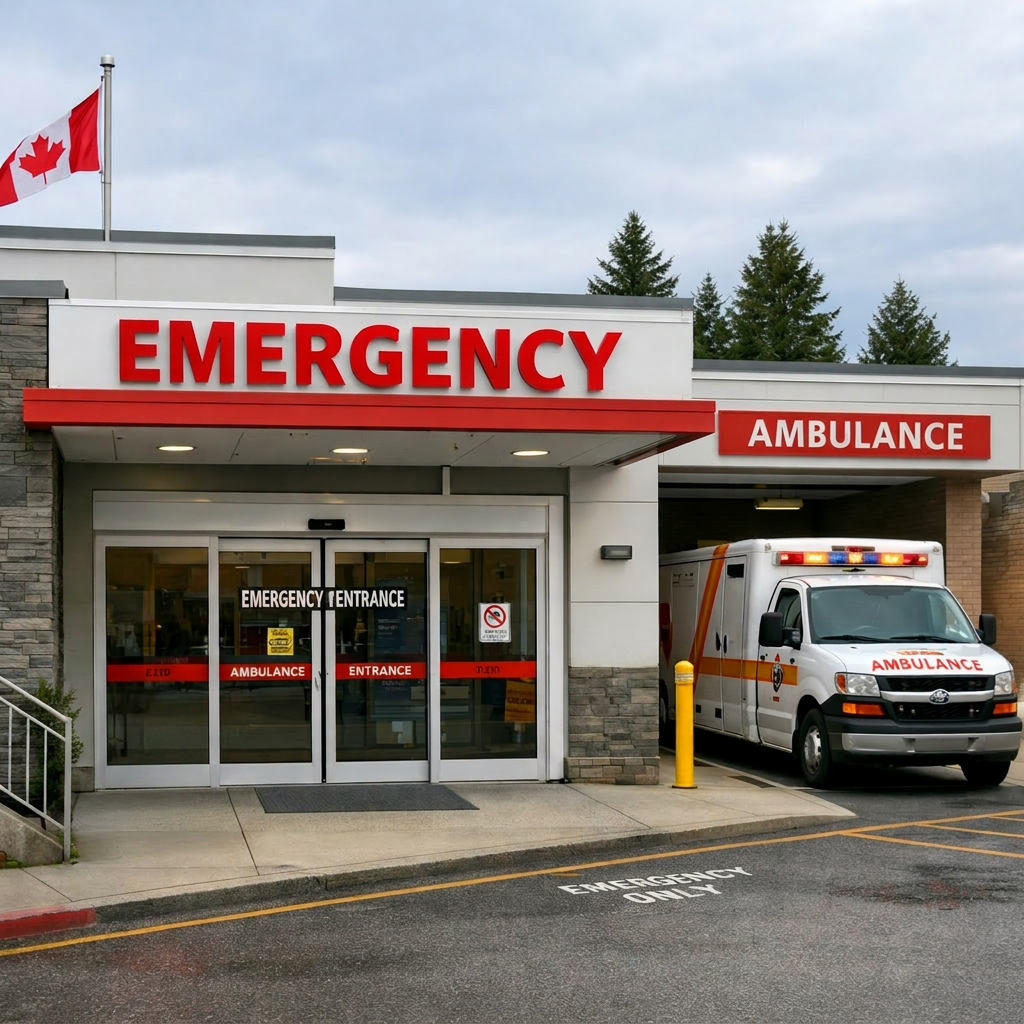
Accessibility to 24-hour emergency services in Canada is measured by travel time and distance using the Canadian Accessibility and Remoteness Index methodology.
Citations:
McGaughey, T. & Peters, P. A. (2024) “Where should we go - Estimating travel times for modelling accessibility to 24-hour emergency departments in Canada.” Scientific Data 11, 853. https://doi.org/10.1038/s41597-024-03691-5.
McGaughey T, Peters PA. Introducing the Canadian Accessibility and Remoteness Index (CARI+). Can Geogr Le Géographe Can 2026;70. https://doi.org/10.1111/cag.70082.
In a publicly funded, universal health care system like Canada’s, the principal expectation is that every member of the population has equal and equitable access to healthcare services. Although there is general agreement about the importance and application of this principle in the Canadian healthcare system, where basic healthcare is provided for free to all Canadian citizens, the true accessibility of these resources comes into question. One way to better support the research these policy makers would be founding their decisions on is to map the current resources available and estimate the populations accessibility to healthcare resources.
This version of the CARI+ measure was calculated using the general methodology for CARI+, as described in Canadian Geographies / Géographies canadiennes. This was adapted to calculate accessibility for hospitals in Canada with 24-hour emergency departments (EDs). It was achieved by measuring from population-weighted DA centroids to the closest 24h ED instead of the closest service centres.
The hospitals used to measure the distance and time traveled were based on the Open Database of Healthcare Facilities (ODHF) at Statistics Canada. Not suitable facilities were identified by checking the North American Industry Classification System (NAIC) codes and searching keywords in their names. This was then verified using the hospitals’ public data to confirm they offer 24h emergency services.
Interpretation
The purpose of the analysis is to understand the measure of accessibility for 24h emergency departments depending on a population’s geographic location, as indicated by the travel time and distance. This can be interpreted as a relative measure of access between small geographic areas (DAs) to 24-hour ED locations.
The continuous index can be used within statistical modelling as a measure of access, while the categorical scores can be mapped to show areas with higher or lower access. Additionally, the latter can also be included in statistical modelling as a categorical or ordinal measure. A better understanding of essential healthcare accessibility, such as 24-hour EDs, across communities, cities, and provinces is crucial for identifying gaps, uncovering underlying issues, and directing support to areas where it is most needed.
For example, the CARI+ score and/or classification can be used as a covariate alongside other individual and area-based measures such as demographics (e.g., race, gender, age) and
socioeconomic factors (e.g., income, education) in a study on rates of emergency department admissions in rural Canada. Specifically, in rural contexts, the data can be used to assess the relationship between 24-hour ED accessibility and the degree of marginalization, where present.
Future goals using the analysis include expanding the process to include varying levels of rurality, incorporating non-emergency, specialized care, and long-term care facilities, comparing the model to real-world healthcare use, and finally, creating interactive public databases that can be updated over time.
Definitions and Limitations
- Emergency departments: The Emergency Departments (ED) included are operated on a 24h basis and are hospital-based.
- Availability: Since EDs can close temporarily (evident in smaller communities such as Perth, Smiths Falls, Almonte, etc.), availability of services may vary (Callan & D’Mello, 2025; Ireton, 2024). Additionally, some facilities may have closed or relocated, as seen for example in New Brunswick with hospital closures. The accessibility measurement does not account for availability of services needed by the individuals seeking out 24h EDs. This does not account for the limitations to access other than travel time and distance, such as wait times, appropriateness of services available, etc.
Access
2021 census population counts for DAs and CSDs were used, alongside the road networks available in 2024. List of hospitals were obtained in 2024, the same year the data was analyzed. The frequency of updates is as needed.
- Calculation Year: Access scores will vary for other years as service locations open or close over time and as the underlying population distribution changes. Differences will also occur across census periods and may vary in between them as well.
Selected References
- Callan, I., & D’Mello, C. (2025, October 6). Emergency room closures drop in Ontario as critics urge government to make data public. Global News.
https://globalnews.ca/news/11456785/ontario-emergency-room-closure-reduction/. - Ireton, J. (2024, December 10). Should some rural ERs close permanently if new and better support services are in place? | CBC News. CBC News.
https://www.cbc.ca/news/canada/ottawa/rural-er-issues-should-some-close-permanently-1.7402517. - McGaughey T, Peters PA. Introducing the Canadian Accessibility and Remoteness Index (CARI+). Can Geogr Le Géographe Can 2026;70. https://doi.org/10.1111/cag.70082.